
How to Control Blood Sugar and Prevent Metabolic Complications
The Silent Warning of Elevated Blood Sugar
Did you know that elevated blood sugar levels can affect your health without you even realizing it?
Many people have higher-than-ideal glucose levels and experience no obvious symptoms.
No pain.
No fever.
No dramatic warning signs.
However, this doesn’t mean nothing is happening inside your body.
According to the International Diabetes Federation, more than 537 million adults worldwide are living with diabetes — and nearly half of them don’t even know they have it.
But what many people don’t realize is that diabetes rarely appears overnight.
Before diabetes develops, many people go through a stage called prediabetes.
And even earlier than that, the body may begin developing insulin resistance.
This condition can develop quietly, often without noticeable symptoms.
You may have noticed signs such as:
Frequent fatigue
Feeling hungry soon after meals
Difficulty losing weight
Feeling sleepy after eating
These symptoms may seem common, but they can sometimes signal that your body is not using glucose efficiently.
How can you know if your blood sugar levels are healthy?
Here are the general fasting blood glucose reference ranges:
✔ 70–99 mg/dL — Normal range
⚠ 100–125 mg/dL — Prediabetes (a sign that closer attention may be needed)
🚨 126 mg/dL or higher — Diagnostic threshold for diabetes
The difference between healthy levels and increased risk can be just a few points.
And in many cases, changes in blood sugar levels can begin long before noticeable symptoms appear.
When blood glucose remains elevated over time, it may:
Affect blood vessel health
Contribute to inflammation
Increase stress on the liver
Impact other vital organs over time
These changes can occur gradually and often go unnoticed in the early stages.
The good news?
In many cases, progression toward type 2 diabetes can be slowed or prevented.
Research shows that early lifestyle interventions can reduce the risk of developing type 2 diabetes by up to 58%.
Awareness is the first step toward improving blood sugar balance.
Managing blood sugar isn’t just about avoiding sweets.
It also involves understanding how lifestyle factors influence metabolism:
Stress can raise cortisol, which may increase blood sugar
Poor sleep can reduce insulin sensitivity
A sedentary lifestyle can make glucose harder for cells to use
Refined carbohydrates can lead to spikes and crashes in energy
Your body was designed to function with balance — not constant blood sugar swings.
And balance comes from consistent, sustainable daily habits:
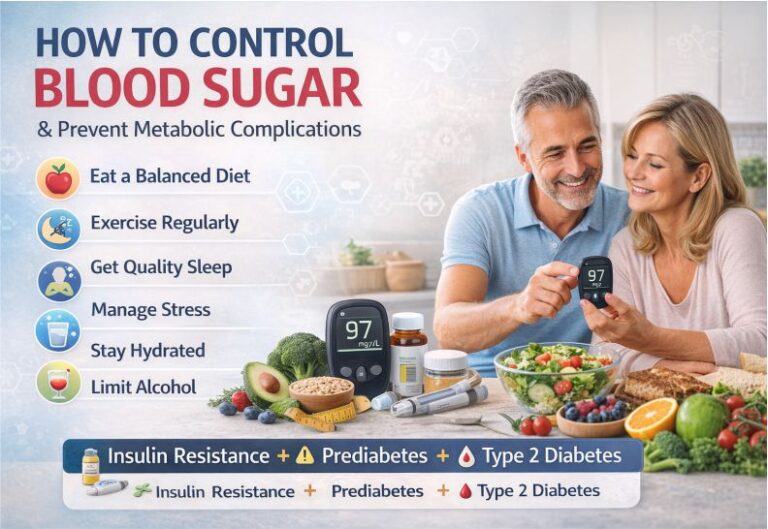
✔ Adjust your diet toward balanced nutrition
✔ Stay physically active
✔ Prioritize quality sleep
✔ Manage stress effectively
✔ Monitor your health through regular lab testing
Ignoring elevated blood sugar today may increase the risk of more serious health concerns over time.
The encouraging part?
The body has an impressive ability to recover when given the right support.
Taking action early may help restore balance and protect your long-term health.
So the question becomes:
Will you wait until symptoms appear…
Or will you take steps now to protect your health?
Your next lab result may just be a number.
Or it may be an important signal.
The choice starts today.
Send us your questions or suggestions
References: Simoes ICM, Karkucinska-Wieckowska A, Janikiewicz J, Szymanska S, Pronicki M, Dobrzyn P, Dabrowski M, Dobrzyn A, Oliveira PJ, Zischka H, Potes Y, Wieckowski MR. Western Diet Causes Obesity-Induced Nonalcoholic Fatty Liver Disease Development by Differentially Compromising the Autophagic Response. Antioxidants (Basel). 2020 Oct 15;9(10):995. doi: 10.3390/antiox9100995. PMID: 33076261; PMCID: PMC7602470. Zhang J, Powell CA, Kay MK, Sonkar R, Meruvu S, Choudhury M. Effect of Chronic Western Diets on Non-Alcoholic Fatty Liver of Male Mice Modifying the PPAR-γ Pathway via miR-27b-5p Regulation. Int J Mol Sci. 2021 Feb 12;22(4):1822. doi: 10.3390/ijms22041822. PMID: 33673073; PMCID: PMC7917964. Cremonese C, Schierwagen R, Uschner FE, Torres S, Tyc O, Ortiz C, Schulz M, Queck A, Kristiansen G, Bader M, Sauerbruch T, Weiskirchen R, Walther T, Trebicka J, Klein S. Short-Term Western Diet Aggravates Non-Alcoholic Fatty Liver Disease (NAFLD) With Portal Hypertension in TGR(mREN2)27 Rats. Int J Mol Sci. 2020 May 7;21(9):3308. doi: 10.3390/ijms21093308. PMID: 32392802; PMCID: PMC7246932.
For all products featured, results may vary. Please visit the product websites for further information.
These statements have not been evaluated by the FDA. These products are not intended to diagnose, treat, cure, or prevent any disease.
The information on this website is not intended as a substitute for professional medical advice. If you have, expect to have, or suspect you may have any medical condition, we recommend you consult with a physician.